Selection Criteria Examples (STAR Method)

Worked STAR examples for the selection criteria that come up most often in Australian job applications — common in government, health, education and council roles. Use them as a model for structure, then write your own answer with a real example from your experience.

Prove the skill with the STAR method

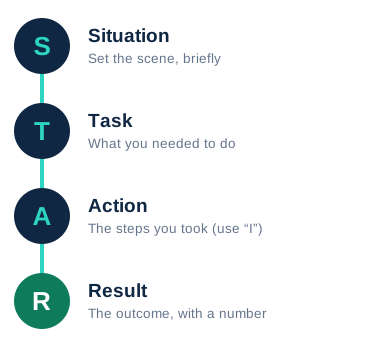
Selection criteria ask you to prove a skill with evidence, not just claim it. The clearest way is the STAR method: set the Situation, the Task, your Action, and the Result. New to it? Start with our step-by-step guide on how to address selection criteria, then use the worked examples below.

Each example is fictional and written to show the structure, so use it as a template only. Assessors can spot a generic answer and you need to speak to your example honestly at interview — always swap in a real situation of your own.

The STAR method: Situation, Task, Action, Result

Worked examples by criterion

Ten of the most common selection criteria, each with a full STAR example to model your own answer on.

Communication skills (written and verbal)

Example wording: "Demonstrated ability to communicate clearly with a range of audiences."

Situation
At a community health centre, many clients spoke English as a second language and often found our appointment letters confusing.
Task
I was asked to help reduce missed appointments, which were running at about one in five.
Action
I rewrote the standard letter in plain English, added a short SMS reminder, and briefed reception staff on confirming key details verbally at the time of booking.
Result
Missed appointments fell from around 20% to about 9% over three months, and clients told us the new letter was much easier to understand.

Teamwork

Example wording: "Works effectively as part of a team to achieve shared goals."

Situation
Our retail team was short-staffed during a major stocktake with a tight deadline.
Task
As a team member, I needed to help complete an accurate count across three departments in two days.
Action
I volunteered to coordinate the homewares section, split the tasks with two colleagues, and shared a quick progress update each hour so we could rebalance if anyone fell behind.
Result
We finished on time with a 99.6% accuracy rate, and my manager adopted the hourly check-in for future stocktakes.

Customer and client service

Example wording: "Delivers high-quality service to customers or clients."

Situation
A frustrated customer came to our service desk after a delivery had failed twice.
Task
I needed to resolve the problem and rebuild their confidence in us.
Action
I listened without interrupting, apologised for the inconvenience, arranged a priority redelivery for the next morning, and gave them a direct number to reach me if anything went wrong.
Result
The delivery arrived as promised, the customer left a positive review that named the service, and they stayed a regular customer.

Problem-solving

Example wording: "Identifies problems and develops practical solutions."

Situation
Our small office kept running out of a key consumable, which caused delays.
Task
I was asked to stop the recurring shortages without increasing the budget.
Action
I tracked usage for a month, found the reorder point had been set too low, and set up a simple shared spreadsheet that flagged when it was time to reorder.
Result
We had no further shortages over the next six months and cut the number of rushed, higher-cost orders.

Managing competing priorities and deadlines

Example wording: "Manages competing priorities and meets deadlines."

Situation
During end-of-month, I had to process invoices, prepare a report, and cover a colleague’s reception duties.
Task
All three were due in the same week.
Action
I listed each task with its deadline, blocked focused time for the report in the mornings, batched the invoices in the afternoons, and checked priorities with my manager when two clashed.
Result
I met every deadline that week and submitted the report a day early with no errors.

Attention to detail and accuracy

Example wording: "Maintains a high level of accuracy and attention to detail."

Situation
I was responsible for entering client data that fed into monthly compliance reports.
Task
Even small errors could cause problems further down the line.
Action
I built a short checklist for each entry, cross-checked figures against the source documents, and flagged anything unclear rather than guessing.
Result
Over twelve months my entries had no reported errors, and my checklist was shared with new starters.

Initiative and working independently

Example wording: "Uses initiative and works with minimal supervision."

Situation
While my supervisor was on extended leave, I noticed the filing backlog was steadily growing.
Task
No one had been assigned to it, but it was starting to slow the team down.
Action
I proposed a simple plan to clear it, set aside an hour each day, and kept a short log so my supervisor could see progress on their return.
Result
The backlog was cleared within three weeks, and my supervisor asked me to document the new filing process.

Adaptability and managing change

Example wording: "Adapts to change and stays effective in a changing environment."

Situation
Our team switched to a new booking system with only a week’s notice.
Task
I had to keep serving customers while learning the system myself.
Action
I finished the online training early, made a one-page cheat sheet of the most common tasks, and helped two colleagues who were less confident with the technology.
Result
Our counter kept running with no increase in wait times, and the cheat sheet became the team’s quick reference.

Leadership and supporting a team

Example wording: "Leads and supports a small team." (for supervisory roles)

Situation
As shift supervisor, I led a team of five during our busiest trading period.
Task
I had to keep service standards high while training two new staff.
Action
I set clear roles at the start of each shift, paired new staff with experienced team members, and gave quick, specific feedback after the busy periods.
Result
We held our service times through peak season, and both new staff passed their probation early.

Stakeholder engagement

Example wording: "Builds and maintains effective relationships with stakeholders."

Situation
A project I supported needed input from three teams that rarely worked together.
Task
I was asked to gather their requirements, even though I had no formal authority over them.
Action
I met each team lead one-on-one first, summarised their needs in a shared document, then ran a short combined meeting to agree on priorities.
Result
All three signed off on the requirements within a fortnight, and the project started on schedule.
Checklist representing stronger selection criteria responses

Tips that make responses stronger

  • One strong example beats three weak ones. Choose a situation that genuinely shows the skill.
  • Lead with “I”. Assessors want to know what you did, even in a team effort.
  • Finish with a result. A number, a time saved, or a clear outcome makes your answer land.
  • Mirror the language of the criterion where it honestly fits, but never keyword-stuff.
  • Respect the limit. If it says 250 words or a character count, stay within it.

When your examples are ready, sharpen the rest of your application: start from a free ATS-friendly resume template, add a matching cover letter, and run your resume through the free ATS resume checker before you submit.

Frequently asked questions

What is the STAR method?

STAR stands for Situation, Task, Action and Result. It is a simple structure for answering selection criteria and interview questions with real evidence: set the scene, say what you needed to do, explain the specific actions you took, and finish with the outcome — ideally something measurable.

How long should each selection criteria response be?

Follow the limit the employer sets. Many Australian applications give a word or character limit per criterion, often around 250 words or a set number of characters. If no limit is given, a short, focused paragraph or two using one strong STAR example is usually enough.

Can I copy these examples into my application?

No. Use them only as a structure to model your own answers on. Assessors read many applications and can tell when an example is generic or not your own, and you need to be able to speak to it honestly at interview. Always use a real situation from your own experience.

What is the difference between selection criteria and a cover letter?

A cover letter is a broader pitch for why you suit the role. Selection criteria responses give specific evidence against each listed requirement, usually under a heading for each criterion. Some Australian roles ask for both, and some ask for a single one or two page "pitch" or "statement of claims" instead.

Do private-sector jobs use selection criteria?

Formal selection criteria are most common in government, health, education and the not-for-profit sector. Private-sector roles use them less often, but the same STAR approach is just as useful for cover letters and interview answers.

How many criteria do I need to address?

Address every criterion listed, unless the application says otherwise. Use a clear heading for each one so the assessor can quickly see you have covered it, and give a separate example where you can rather than reusing the same story for everything.

These selection criteria examples are free, general templates to adapt — they are fictional and provided for information only. JobCall.com.au is not legal, employment-law, HR, recruitment or career counselling, and using these examples creates no professional relationship. Selection criteria requirements differ between employers and agencies and change over time; always follow the specific instructions, headings and word or character limits in the role you are applying for, and use genuine examples from your own experience. Do not copy these examples verbatim.